Sunday, March 23, 2014
Chapters 16-19, F
Tom Joad is a man who has a strong belief system. He believes in pragmatism & the idea of going with the current. He is more about practicality & likes to do whatever it takes to get to the next stage in his life, not thinking about the past or future. In comparison to Jim Casy's idealistic nature, Tom's actions are more intuitive, as well as his insights. Tom is more practical because he concerns himself with the practical aspects of life, for they relate to the here & now type of situations. He does not care for or acknowledge the circumstances that may surround him as results from his actions. He is temperamental, independent, & a man of action. His pragmatic nature derives from his actions speaking for him. He is a kind & merciful soul, but he can quickly become very fierce.

*Chapters 16-19, A
Rules of Migrant Society
-
You have:I. The right to keep your past unknown to others.II. The right to be fed if hungry or feed others if they are hungry.III. The right to remain quiet when the camp is asleep.IV. The right to privacy in a tent.V. The right to talk and to listen.VI. The right to refuse help or accept it.VII. The right to offer help or decline it.VIII. The right to court if you are a son, and the right to be courted if you are a daughter.IX. No right to commit the act of seduction or rape.X. No right to commit adultery, theft or murder.
- In the Grapes of Wrath, the rules and laws of the migrant society were never officially stated or written. They were known through learning how to survive in the camps during the journey to California. Two of the unspoken rules of the camping societies were that the migrants had the right to refuse or accept help, and the right to offer or decline help. Self reliance is such a huge & continuous theme throughout the novel. Although you may want to retain your dignity & refrain from asking for help or any type of assistance, when your living conditions are similar to those of the Joads & the other families in the story, it is a bit difficult to not ask for any help. Even if you do not physically ask anyone or help, the migrants in these camping societies still offered it. They do not expect anything back, but they know that if faced with a similar dilemma, they would want as much help as well. This is what occurred when the many farmers & their families driven out of their land were forced to come together. Once unified, they were family. Although not blood relatives, they were still family because of the similar situations, emotions, & many other similarities that they shared. They struggled together, and as a result they cared & loved for eachother. The two rules did not have to be spoken to be known that they were to be followed. They were basic qualities of a living organism. Most of these people had those qualities & knew because of human instinct. The unspoken rules guided the camping societies in helping eachother out & to not be selfish. (Ignore the extra numbers!)
Monday, March 17, 2014
Chapters 11-15, D
"The night draws down. The baby has a cold. Here, take this blanket. It's wool. It was my mother's blanket--take it for the baby. This is the thing to bomb. This is the beginning--from "I" to "we"." (152)
"For the quality of owning freezes you forever into "I", and cuts you off forever from the "we"." (152)
"The Western States are nervous under the beginning change. Need is the stimulus to concept, concept to action. A half-million people moving over the country; a million more restive, ready to move; ten million more feeling the first nervousness. And tractors turning the multiple furrows in the vacant land." (152)
I was very much captivated by all of page 152 from The Grapes of Wrath. The idea of unity really captures my attention because I strongly believe in movements of masses. I found these 3 quotes to be the main ones to support the idea of unity. To begin the process of unity, you need to take action, especially in times of need. Wholeness focuses on the basic concept of action, & that of rational action. In grasping this concept, our minds easily correlate this idea with wealth, value, price, cost, abundance, scarcity, advantages, disadvantages, success, profit & loss. These ideas are implied when the course of action is taken. Action is usually triggered by dissatisfaction. There is always a possibility of alleviating that dissatisfaction by taking action. This is what we begin to see in the novel The Grapes of Wrath. There is a shift in society, with a gradual emergence of unity rather than loneliness. "I" changes to "we". In the chapters before, Steinbeck describes the growing anger & bitterness of the tenant farmers. In the wake of weariness, fright, dissatisfaction & hunger, these people join together. They are victims under the same circumstances & share the same struggles, & they realize this. They recognize that there is strength in numbers. They share what little they have with eachother, & know that by being together they will survive.
"For the quality of owning freezes you forever into "I", and cuts you off forever from the "we"." (152)
"The Western States are nervous under the beginning change. Need is the stimulus to concept, concept to action. A half-million people moving over the country; a million more restive, ready to move; ten million more feeling the first nervousness. And tractors turning the multiple furrows in the vacant land." (152)
I was very much captivated by all of page 152 from The Grapes of Wrath. The idea of unity really captures my attention because I strongly believe in movements of masses. I found these 3 quotes to be the main ones to support the idea of unity. To begin the process of unity, you need to take action, especially in times of need. Wholeness focuses on the basic concept of action, & that of rational action. In grasping this concept, our minds easily correlate this idea with wealth, value, price, cost, abundance, scarcity, advantages, disadvantages, success, profit & loss. These ideas are implied when the course of action is taken. Action is usually triggered by dissatisfaction. There is always a possibility of alleviating that dissatisfaction by taking action. This is what we begin to see in the novel The Grapes of Wrath. There is a shift in society, with a gradual emergence of unity rather than loneliness. "I" changes to "we". In the chapters before, Steinbeck describes the growing anger & bitterness of the tenant farmers. In the wake of weariness, fright, dissatisfaction & hunger, these people join together. They are victims under the same circumstances & share the same struggles, & they realize this. They recognize that there is strength in numbers. They share what little they have with eachother, & know that by being together they will survive.
Wednesday, March 12, 2014
*Highway 66 (Ch. 11-15, B)
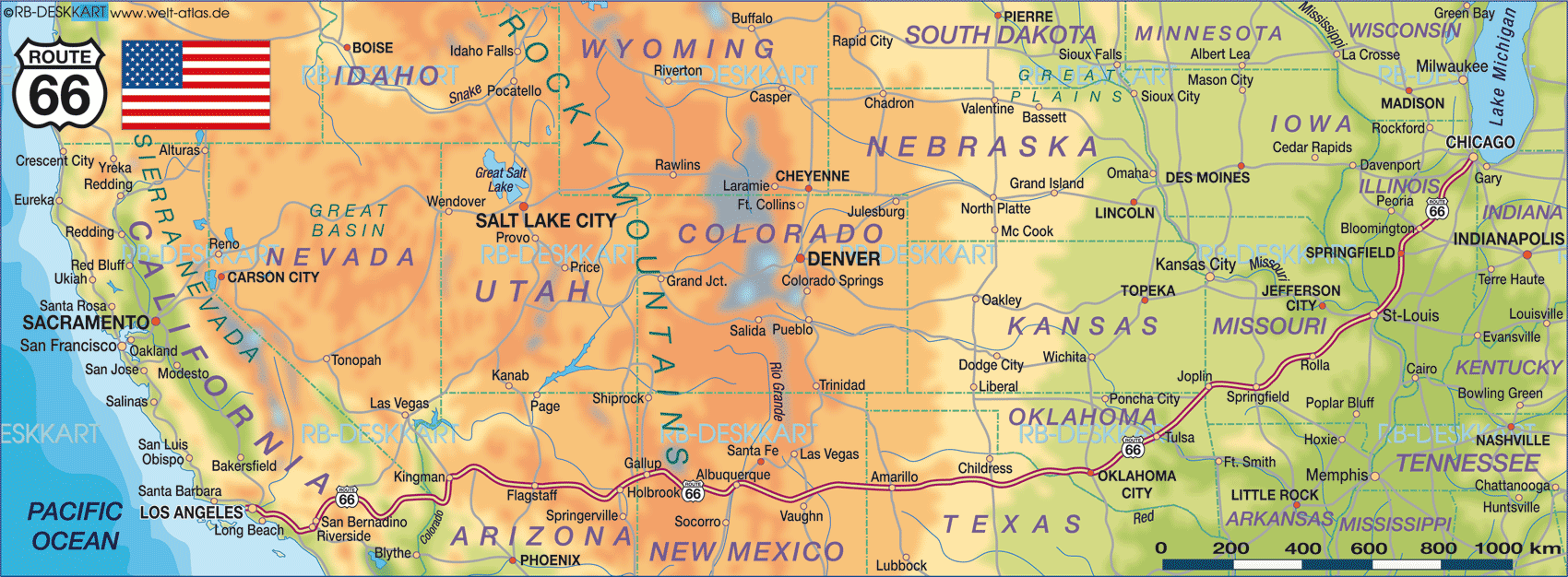
Route 66 was born in November of 1926, & was completely paved by 1938. The route ran from Chicago to Santa Monica. Between the years of the Depression, small farmers packed little of their belongings and started out towards the promised state of California. They loaded their trucks with family members, livestock, & household items, & head out along the road. The business people along the route often had compassion for these travelers & gave them gas, food, or meals that would get them closer to their destination. Although the final stop was California, many families settled in Arizona & New Mexico to begin their new lives.
In the times of struggle & misery, individuals often unite & help one another. “The road not only brought the MidWesterners [sic] to California but it also brought the people together along the way. Route 66 with its bumpy and uneven pavement and the car with its numerous flat tires, forced people to come to each other’s rescue. Lonely hitchhikers were assimilated into traveling families. Children found comfort in any migrant mother along the way. Men joined together in efforts to begin strikes or just hold meetings. Thus, these people, despite coming from four or five different states, were fused together by their same backgrounds, problems, and will to survive” (“The Dust Bowl and It’s People” 2012). Route 66 brought together different people from diverse cultures as one group, one nation. Many families that had experienced the Dust Bowl, such as the Joads, migrated West to California through Route 66.


http://www.route66university.com/study/history.php
https://sites.google.com/site/route66meaning/1-history-of-route-66/1-2-the-road-of-flight---the-role-of-the-route-66-during-the-great-depression-period
In the times of struggle & misery, individuals often unite & help one another. “The road not only brought the MidWesterners [sic] to California but it also brought the people together along the way. Route 66 with its bumpy and uneven pavement and the car with its numerous flat tires, forced people to come to each other’s rescue. Lonely hitchhikers were assimilated into traveling families. Children found comfort in any migrant mother along the way. Men joined together in efforts to begin strikes or just hold meetings. Thus, these people, despite coming from four or five different states, were fused together by their same backgrounds, problems, and will to survive” (“The Dust Bowl and It’s People” 2012). Route 66 brought together different people from diverse cultures as one group, one nation. Many families that had experienced the Dust Bowl, such as the Joads, migrated West to California through Route 66.
http://www.route66university.com/study/history.php
https://sites.google.com/site/route66meaning/1-history-of-route-66/1-2-the-road-of-flight---the-role-of-the-route-66-during-the-great-depression-period
Saturday, March 8, 2014
*Man vs. Nature (Ch.1-10,G)
The everlasting antagonist, nature, presents itself in the novel "The Grapes of Wrath" by John Steinbeck. The theme of man vs. nature portrays the human struggle to survive against a hostile environment. Steinbeck starts off the novel with an ominous wind sweeping through the land of Oklahoma, which foreshadows the Dust Bowl of the 1930s. The wind lifted the land so high from it's roots that the atmosphere became dark and the sun appeared, "a dim red circle that gave a little light, like dusk; and as that day advanced, the dusk slipped back toward darkness, and the wind cried and whimpered over the fallen corn" (2). The farmers and their families were incredibly fearful of this unusual storm and how it was destroying their crops. The men stood silently and thought. Children emerged from their houses, but they did not run or play. Then the women came out of their houses, wearing weary lines on their faces as they watched their husbands. They knew the amount of destruction nature was capable of., and worried that the men would break, stood beside them & "studied the men's face secretly, for the corn could go, as long as something else remained" (3). But once the "watching men lose their bemused perplexity and became hard & angry & resistant" (3) the women knew that they would be safe because they understand that when a man is whole, then there is nothing to great too bear. In Chapter 1 of the novel, Steinbeck sets the tone of the story and reveals a motif that will continue throughout the novel. The harshness of nature will present many obstacles for the Joads; encounters with social chaos, inhumanity, & other unthinkable situations.
Friday, March 7, 2014
Automobile Industry 1930s (Chapter 7, D)
The Great Depression had ruined the automobile industry. Workers for the three big automobile companies at the time--GM, Ford, & Chrysler-- were laid off and had lost their job security and stability in the process. The auto industry's response to the Great Depression was to lay off workers, make wage cuts, and increase the speed of production. At the start of the Depression, car companies were mostly small and specialized. By the end of the decade, they had transformed into large and strong corporations.
In the 1930s, cars were the nation's symbol of leisure, convenience, & security. Middle class & farming families were reluctant to give up driving, even in the worst years of the Depression. But when the Dust Bowl occurred in the Midwest region of Oklahoma, Kansas, Colorado, New Mexico, & Texas, many farmers in that area wanted to stay and care for their land. Many of them did not buy automobiles & move to California. Only 16,000 of the 1.2 million migrants to California were from the areas where the Dust Bowl had occurred. Many also only moved to neighboring states instead of places far away from their homes. Automobiles were too expensive.

http://www.encyclopedia.com/doc/1G2-3468301097.html
http://www.history.com/news/10-things-you-may-not-know-about-the-dust-bowl
http://rocknrule0723.webs.com/automobiles.htm
In the 1930s, cars were the nation's symbol of leisure, convenience, & security. Middle class & farming families were reluctant to give up driving, even in the worst years of the Depression. But when the Dust Bowl occurred in the Midwest region of Oklahoma, Kansas, Colorado, New Mexico, & Texas, many farmers in that area wanted to stay and care for their land. Many of them did not buy automobiles & move to California. Only 16,000 of the 1.2 million migrants to California were from the areas where the Dust Bowl had occurred. Many also only moved to neighboring states instead of places far away from their homes. Automobiles were too expensive.
http://www.encyclopedia.com/doc/1G2-3468301097.html
http://www.history.com/news/10-things-you-may-not-know-about-the-dust-bowl
http://rocknrule0723.webs.com/automobiles.htm
Subscribe to:
Comments (Atom)